
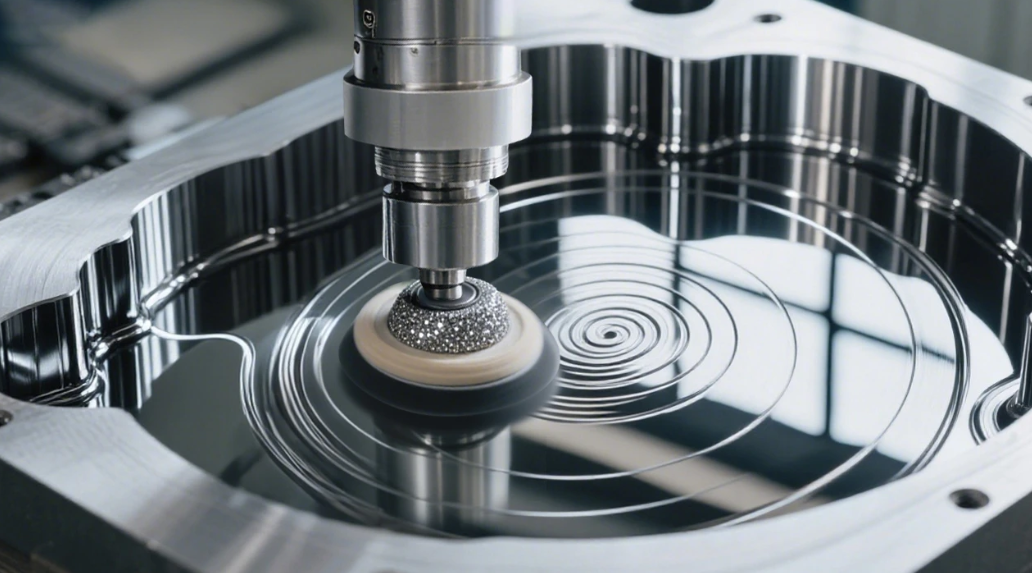
Mold polishing is a critical yet often underestimated process in thermoplastic injection molding. The surface quality of a molded plastic part is a direct replica of the mold cavity surface, making polishing one of the most influential factors affecting part appearance, ejection behavior, cycle time, and overall mold life. A well-polished mold not only enhances the visual quality of plastic components but also improves processing efficiency and long-term tool performance.
In injection molding, mold polishing refers to the controlled refinement of the core and cavity surfaces to remove machining marks, micro-scratches, and surface irregularities. This process is typically performed after CNC machining, EDM, and heat treatment, and it requires both technical knowledge and skilled craftsmanship. For thermoplastic materials, especially those used in cosmetic, optical, or consumer products, surface finish requirements can be extremely demanding, making polishing a decisive step in mold manufacturing.
One of the primary reasons mold polishing is essential is its direct impact on part ejection. Rough or inconsistent surfaces increase friction between the molded part and the cavity wall, leading to higher ejection forces, drag marks, part deformation, or even cracking. A smooth, properly polished surface reduces adhesion between the plastic and steel, allowing easier and more consistent demolding. This not only improves part quality but also helps reduce cycle time and wear on ejector systems.
Mold polishing is predominantly carried out using mechanical or manual methods. The process typically begins with coarse abrasives to remove visible tool marks and progresses gradually toward finer abrasives to achieve the desired surface finish. Common tools include sandpapers, oil stones, diamond stones, polishing sticks, felt wheels, and polishing pastes. Grit progression is a crucial aspect of polishing; skipping intermediate grit sizes can result in deep scratches that are difficult to eliminate later and may require rework.
Depending on the required finish, different levels of polishing are applied. Standard mechanical polishing is sufficient for functional parts where aesthetics are not critical. High-gloss or mirror polishing is used for cosmetic components, transparent parts, or optical applications, where even microscopic surface defects can be visible on the final product. In such cases, ultra-fine diamond compounds and controlled polishing techniques are employed to achieve extremely low surface roughness values. For complex geometries or specific materials, advanced methods such as chemical polishing, electrolytic polishing, ultrasonic polishing, or magnetic polishing may also be used to achieve uniform finishes in difficult-to-reach areas.
Industry standards such as SPI surface finish grades are commonly used to define polishing requirements. These standards help mold makers and customers align expectations by specifying surface quality levels ranging from high-gloss mirror finishes to functional matte surfaces. Selecting the correct polish grade is important not only for appearance but also for part performance, as excessive polishing where it is not required can increase tooling cost without adding functional value.
Best practices in mold polishing include maintaining clean working conditions, following a disciplined grit sequence, frequently inspecting the surface under proper lighting, and ensuring that polishing tools match the mold geometry. Polishing should always follow the natural contours of the cavity to avoid rounding edges, distorting features, or altering dimensional accuracy. Skilled polishers understand how different mold steels respond to polishing and adjust techniques accordingly to avoid defects such as orange peel, pinholes, or uneven gloss.
Ultimately, effective mold polishing contributes significantly to consistent part quality, smoother processing, reduced scrap, and longer mold life. For thermoplastic injection molds, especially those producing high-visibility or precision components, polishing is not merely a finishing operation but a value-adding process that bridges tooling quality with molding performance. Investing time, expertise, and process control in mold polishing pays dividends throughout the entire product lifecycle, from stable production to customer satisfaction.